Cybersecurity
Every day I get messages that start with "Kamil, help…!". A hijacked Facebook account, a drained bank account, clients' ad campaigns in the hands of scammers. Not all of these stories have a happy ending, which is why I'd rather meet you and your team before something happens.
In my "Cybersecurity for teams" training I show how cybercriminals really operate and teach people to spot attacks before someone clicks the wrong link. No technical jargon and no scare tactics – real-life examples and plenty of humour.
- 98% of participants call it the best cybersecurity training they have ever attended
- 30,000+ people trained
- 200+ training sessions delivered
- 4–6 h of practice, examples and answers to your questions
Want your team to stop falling for scams? Let's talk – in 15 free minutes we'll figure out what you need. Prefer writing? Send me a message.
Think it doesn't concern you?
That's what Magdalena thought. And so did a marketing agency that had two-factor authentication switched on. Here are two of the messages I received:
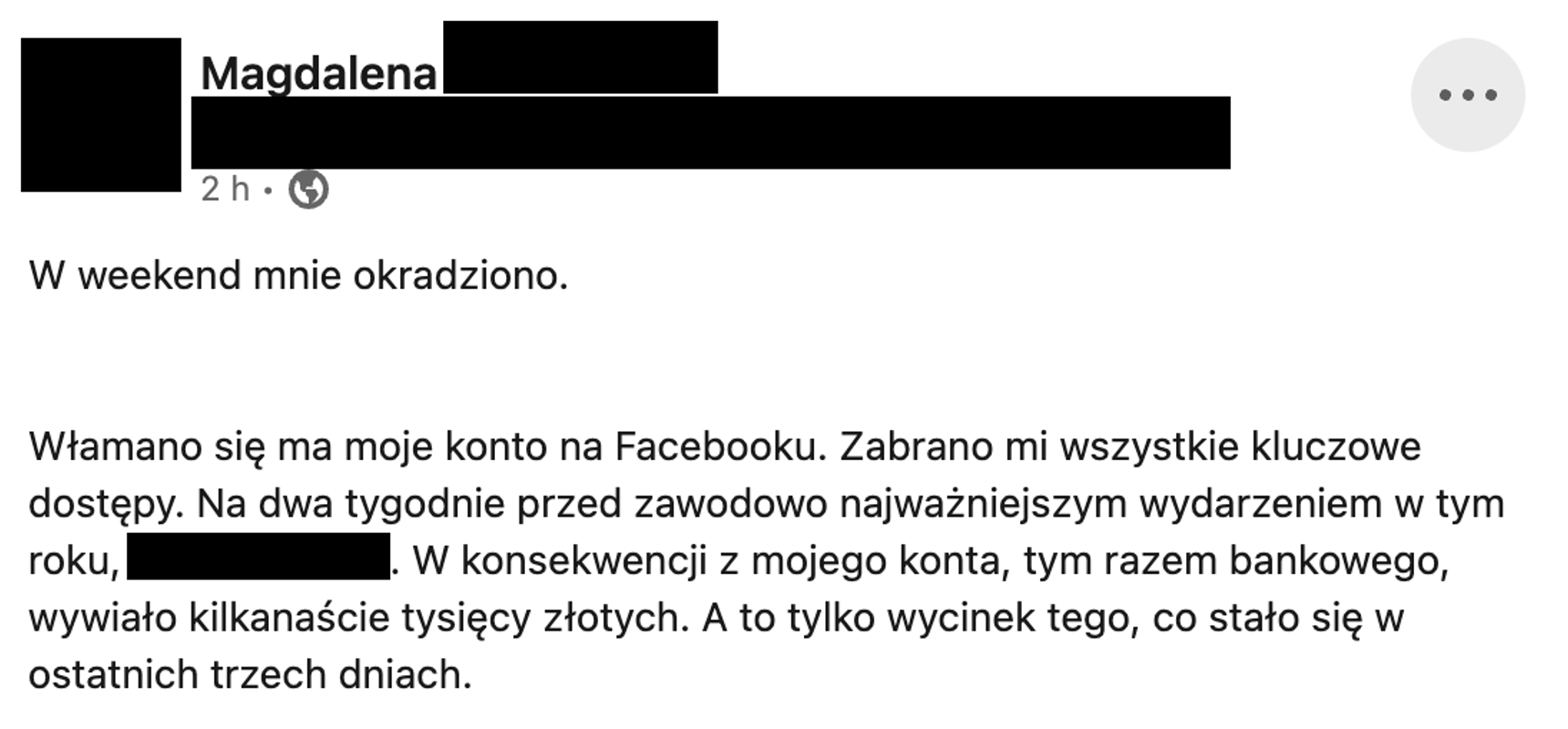
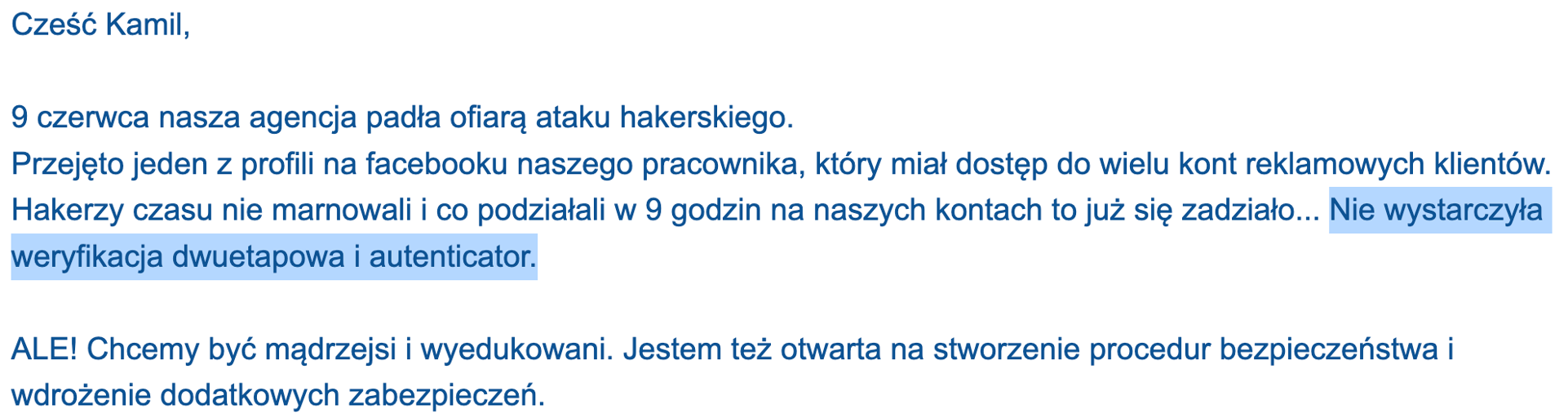
Criminals don't only go after big companies. They go after everyone who has "nothing to steal" – because there's always something: account access, contacts, clients' money or your good name.
Who is this training for?
For everyone who works with a computer, a phone and email – which today means everyone. I train companies and their boards, local governments, foundations, marketing agencies, the e‑commerce, insurance and brokerage sectors, as well as remote teams, virtual assistants, freelancers and content creators.
No technical knowledge needed. I tailor the content and examples to the group, so everyone understands, from the intern to the CEO.
What do you get?
- A team that spots attacks – phishing, fake invoices, people impersonating the boss or the bank.
- Habits that stick – a password manager, two-factor authentication, backups. Participants often set them up during the training itself.
- An incident plan – everyone knows what to do and whom to report to when something goes wrong.
- A practical checklist to check your security level and fill in the gaps.
- An employee benefit – I teach how to protect data at work and at home, so people listen, because it also concerns their private accounts, their kids and their savings.
Training programme
I tailor the programme to the group, but we usually cover these topics:
Why you?
- A brief history of cyberattacks.
- What cybercriminals want from ordinary people and companies.
- "But I've got nothing important" – busting the myth.
How do criminals get into your devices and accounts?
- Phishing in emails, text messages and messaging apps.
- Malicious links, QR codes and typosquatting.
- Social engineering and phone scams.
- Deepfakes and cloned voices.
Passwords and logging in
- How criminals get hold of passwords and how to check whether yours has leaked.
- How to create passwords and which password manager to choose.
- Two-factor authentication and passkeys – what beats a password.
- How to protect your inbox and which email provider to use.
- Hiding your real email address.
Your data online
- Data leaks – where they come from and how to check them.
- What photos and social media posts reveal about you.
- How to secure Facebook, LinkedIn and other accounts.
- Physical tracking of people.
Phone, messaging apps and Wi-Fi
- How to secure your phone and use messaging apps safely.
- Is public Wi-Fi safe, and how people are located through wireless networks.
- Unknown USB sticks, chargers and other plug-in devices.
Safe artificial intelligence
- What data you can paste into AI tools – and what you never should.
- Privacy basics in ChatGPT, Copilot and Gemini.
Remote work, payments and the smart home
- Working from home and on the road, private vs work computers, video calls.
- How not to become a money mule online.
- Paying by phone, online, at ATMs and abroad.
- Smart device security.
When an incident happens
- Backups – how and why to make them.
- What to do when your data has leaked or someone has taken over your account.
- How and to whom to report incidents.
I always leave time for questions at the end – and there are usually plenty. Want to go deeper into AI? See the "Safe artificial intelligence" training.
What do participants say?
Kamil Porembiński is a true online security expert. His lecture was not only valuable in substance but also extremely engaging. He managed to present complex issues in an accessible and often funny way. Most importantly, he shared practical advice that could be put into practice right away.

The best cybersecurity training I have ever attended. Light, witty and a total eye-opener! Highly recommended!

Data security training with Kamil is a must. My whole company listened spellbound – Kamil has a gift. What's more, and this rarely happens, right after the training we implemented a number of Kamil's recommendations, both individually and as a company. I recommend him to everyone!

I took part in Kamil's cybersecurity training. A huge dose of knowledge and practical tips, and a real wake-up call about how easily we can fall victim to a cyberattack. For the first 20 minutes I wanted to switch off the Internet forever, but then Kamil showed us the right tools to protect ourselves.

He trained our whole company in cybersecurity – not only did he share his knowledge brilliantly and get people engaged, he also put us to a practical test and showed live how important this topic is.
In my view, cybersecurity training with Kamil should be as standard as GDPR or health and safety training in every company – with mandatory attendance from the CEO to the junior.

If you think of cybersecurity as a bunch of masked hackers, after Kamil's lecture you finally understand that you have plenty of valuable things that are easy to steal. Your head is spinning, but you just want to say: more, please.

I have trained IBM, Veolia, Wrocław Airport and the city halls of Wrocław and Koszalin, among others. See all my training and more recommendations.
Want to see what it looks like live? Visit my conferences and speeches page – you'll find recordings and photos from the stage there.
How does it work in practice?
- The training lasts 4 to 6 hours, depending on the programme and the number of questions.
- I run it at your office or online.
- For the board, I prepare a shorter version: straight to the point about the risks and what it costs to ignore them.
- Participants get a security checklist, and I tailor the whole training to your industry and tools.
- On request: a recording of the training available for 7 days – for those who couldn't attend live or want a refresher – and a PDF certificate of attendance.
Audits, penetration tests and consulting
Training teaches people. But it's also worth checking whether the systems, websites and procedures in your organisation can withstand a real attack.
- Security audit – I review configuration, access rights, backups and procedures, and you get a list of issues, most urgent first.
- Penetration tests – I attack your websites, applications and infrastructure the way a criminal would, only with your consent and a report at the end.
- Consulting – I help after an incident, when implementing safeguards and when creating security rules for your team.
The combination works best: an audit reveals the weak spots, then training fixes the ones sitting in front of the keyboard.
Let's talk about your company's security
Book a free 15-minute call with me. We'll figure out what you need – training, an audit or consulting – along with the scope and date. In peak season I run no more than 4 training sessions a month, so it's worth booking early. Prefer writing? Send me an email.