How Public Officials Use AI?
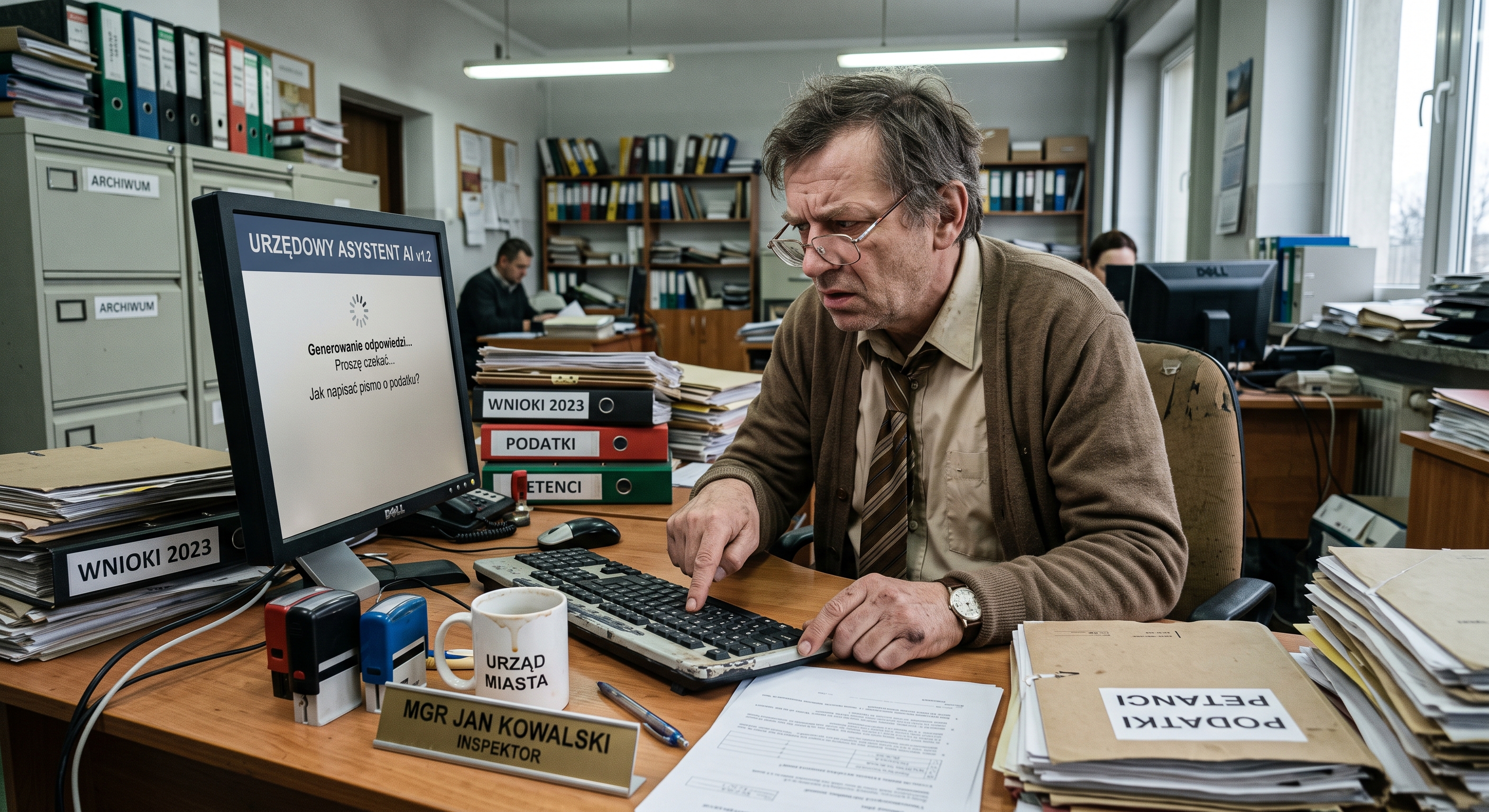
There's a sentence that should hang in every government office above the printer, next to the fire-safety instructions. It was said by the president's photographer, commenting on the Ministry of National Defence's blunder: "Chat rolled in, no time and no vigilance. Off it went." Four words, and they contain the whole story of how Polish public institutions discovered artificial intelligence — and immediately shot themselves in the foot with it.
Because, you see, AI entered government offices by the same route Excel once took for storing passwords: someone heard that "it speeds up work now", clicked, didn't check, hit send. And suddenly an institution with gravitas, a budget and a communications department publishes something that looks like it was generated by a bored teenager at three in the morning.
I'll show you three such cases. From a ministry, through the road authority, to a city. The common denominator is always the same — and at the end I'll tell you what it means for you, because this isn't just a chuckle at someone else's slip-up.
Case one: the MoD, or how to defend a country but not defend a jpg
The deputy head of the Ministry of National Defence went to Poznań for the ceremonies marking the 70th anniversary of June '56 — rightly so, an important date. She came back, posted a photo from the commemorations on X, a nice note about Poznań's Jeżyce district and about values. And it would have been lovely, if not for the fact that the photo had earlier been through an AI "quality enhancement".
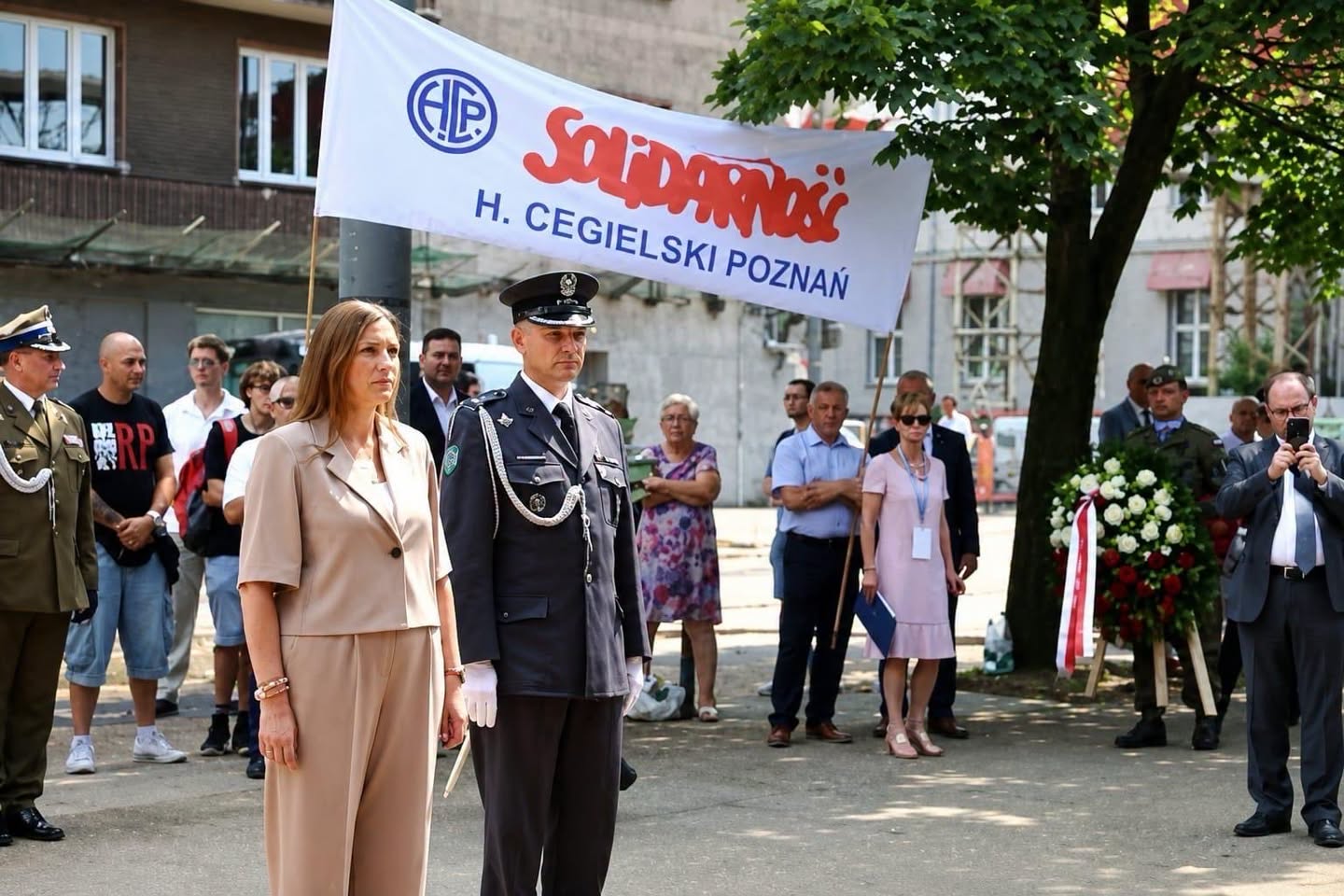
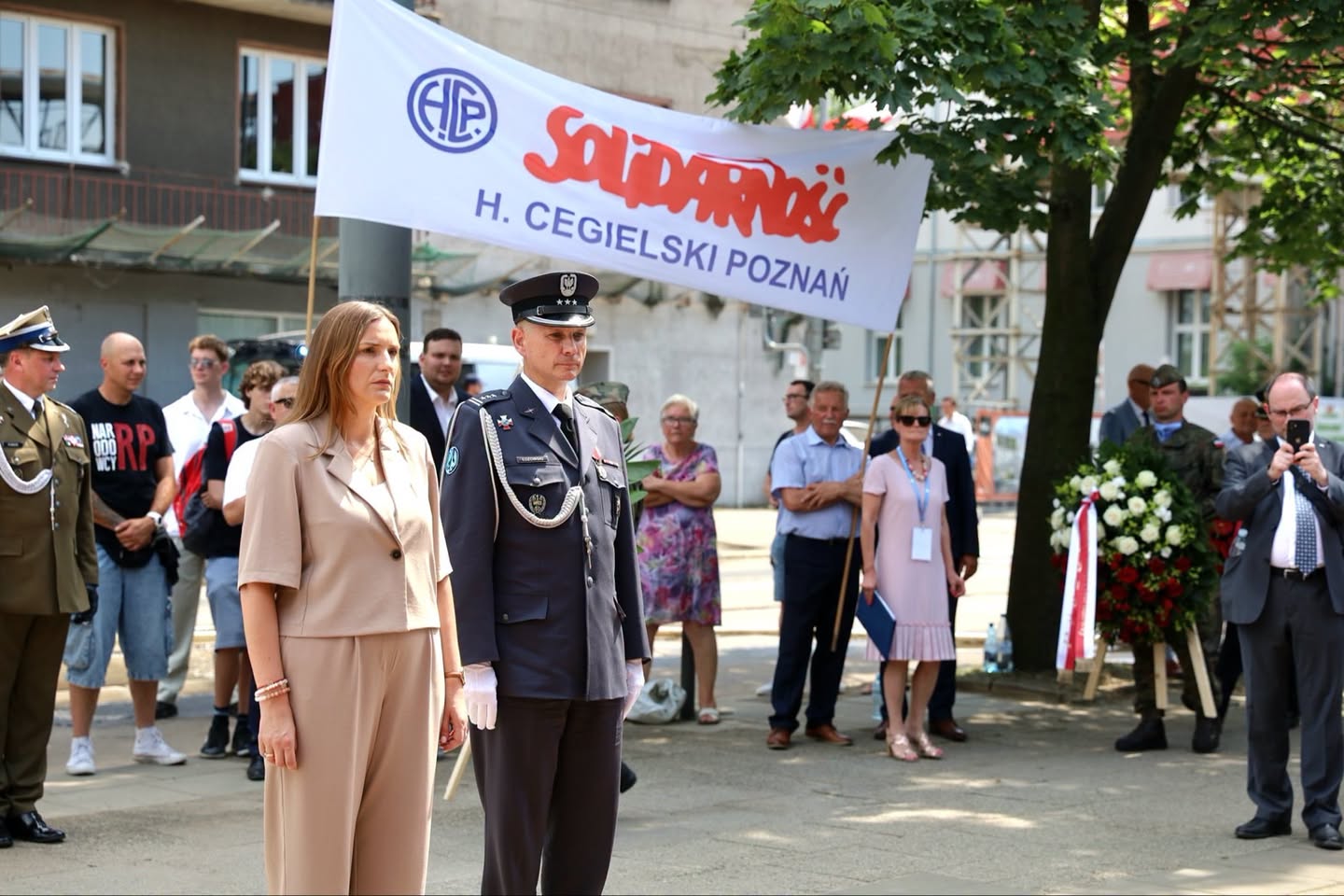
And the artificial intelligence, being what it is, enhanced it. In its own way. On a man standing in the crowd behind the minister it blurred out the slogan on his T-shirt — which happened to read "Narodowcy RP" (Nationalists of the Republic). On the soldier next to him it added some non-standard little ornaments to the uniform that the army probably doesn't allow for in its regulations. Internet users caught it within minutes, and the PiS deputy spokesman politely attached the original and asked why the slogan had disappeared.
The MoD admitted to using AI and issued a statement that it was solely about improving technical quality, and that the modification of elements had been "unintentional". And you know what? They're probably telling the truth. Because that's exactly the whole problem I'll get to in a moment.
Picture it like this: you ask a graphic designer to brighten up a photo from a wedding. You get back a shot in which the uncle has vanished, the aunt has six fingers, and the writing on the cake has changed from "Congratulations" to "Congradulations". And the designer says with full conviction: "I improved the quality." It's not malice. It's a machine that doesn't understand what it sees.
As the president's photographer Mikołaj Bujak aptly summed up: one of the most serious ministries put on "a display of incompetence instead of a display of strength". The Ministry of Defence. It couldn't defend a single photo against Chat.
Case two: the road near Pleszew that nobody needed to make up
This one is even more beautiful, because here there was no pressure, no crisis, no slogan to hide. The General Directorate for National Roads and Motorways in Poznań finished building a two-kilometre pedestrian-and-cycle path along national road 11, on the Janków–Kuczków–Krzywosądów stretch near Pleszew. A real, needed investment, costing nearly four million zlotys. Children will walk to school more safely. All good.
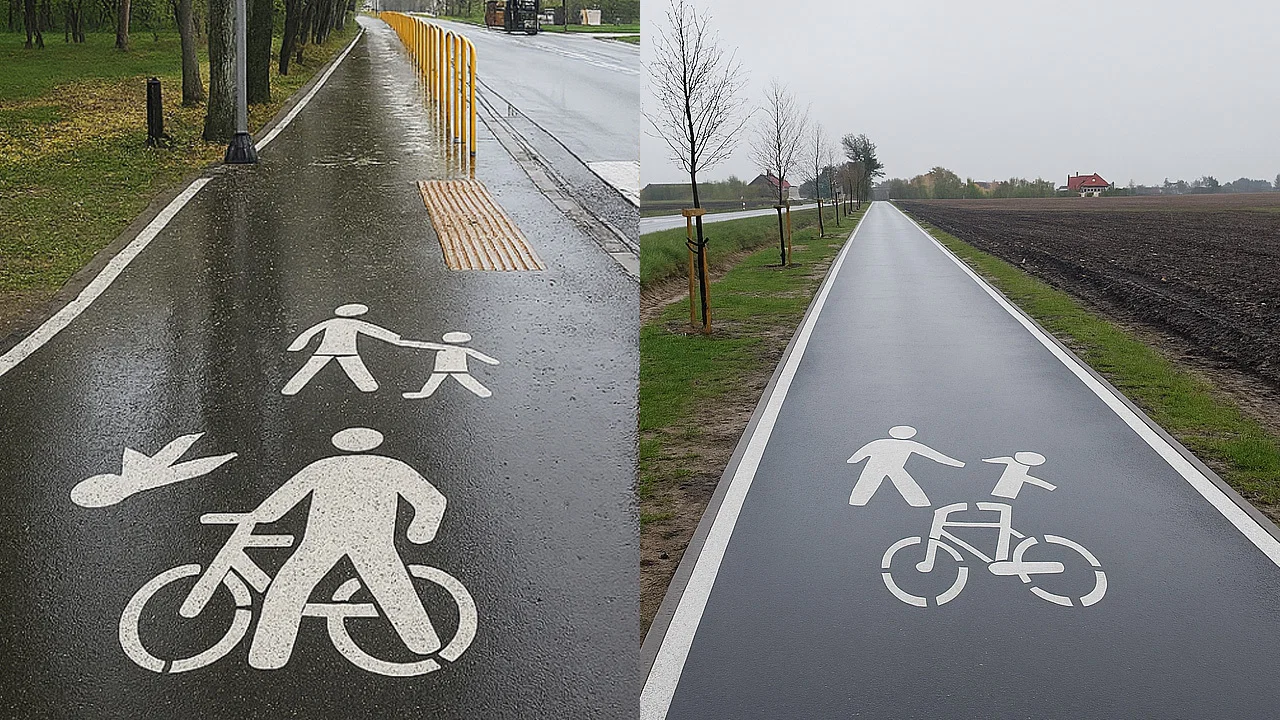
The road people wanted to show off. They had a finished road. They had real photos of the real road. And you know what they did? They ran those photos through AI. The reason — and this is a quote from the spokeswoman — "they wanted there to be no captions at the bottom of the photos". It was about an ordinary watermark. Instead of simply cropping it out, they let the machine in to "clean it up nicely".
The result? The AI generated a road that doesn't exist. A sign with the street name "Kościelna" turned into "Kosceiono". "Pleszewska" ended up as something ending in "gablii". The road signs lost their bicycles and pedestrians, and one, for balance, planted itself in a park. A non-existent square blue sign with a bicycle appeared — the kind that simply doesn't exist in the Polish highway code. The markings painted on the asphalt went haywire too.
So they had a real road and real photos — and they published a fictional road with a "Kosceiono" street, just to get rid of the logo at the bottom. It's a bit like throwing a real wedding and then generating yourself an AI wedding that never happened, only to remove the photographer's little mark from the corner.
The best bit, though, is the spokeswoman's reaction when pressed on why they used AI at all instead of real photos: "Let's focus on what's here now. The photos are what they are" and "nothing will change it now". The photos were indeed quickly swapped for real ones. The garbled mess stayed on the internet forever. FFS.
Case three: Łódź, scouting flowers and asparagus that isn't there
Łódź decided to mark Thinking Day and, on its official fan page, posted a photo of Plac Wolności beautifully decorated with flowers arranged into a scouting fleur-de-lis. Moving, symbolic, pretty. And AI-generated — which the city somehow forgot to mention. No "AI graphic" note, no label. Just a photo, as if someone had gone out to the square in the morning and snapped it on their phone.
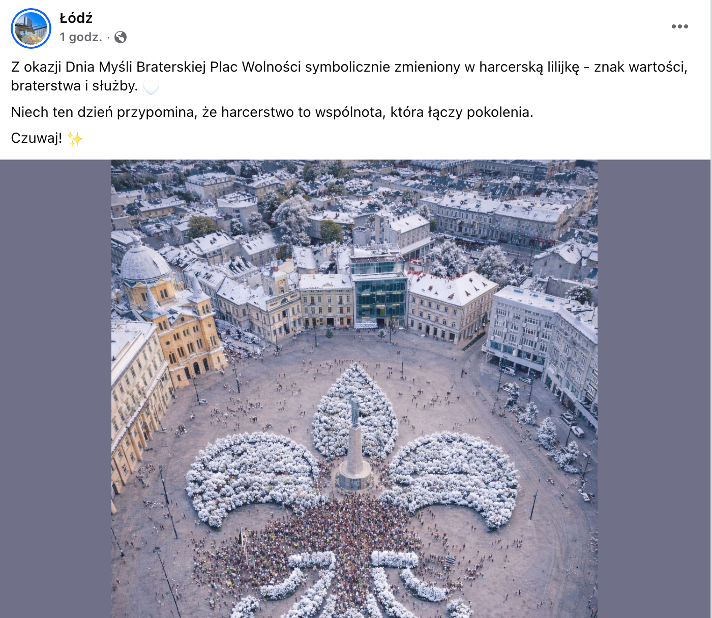
And here begins the part no generator will foresee. Because some residents saw those flowers and did the most human thing under the sun: they got on a tram and went to see them in person. "Oh, nicely done, I'll pop over for a look." They reached Plac Wolności, and there — nothing. No fleur-de-lis, no flowers, a bare square and some puzzled pigeons. They came back annoyed and wrote to the city directly that it had sent them after something that doesn't exist.
And now pay attention, because this is the moment when an institution either grows up or disgraces itself. Łódź chose option two. Instead of apologising and fixing the main post — because that's the one luring people on a wild goose chase — the office started making excuses in the comments: "Yes, it's only a symbolic, AI-generated graphic to remind people of this day". In other words: we didn't label it as AI ourselves, but you should have guessed. Send residents after non-existent flowers and, on top of that, make them out to be naïve fools who couldn't spot the obvious.
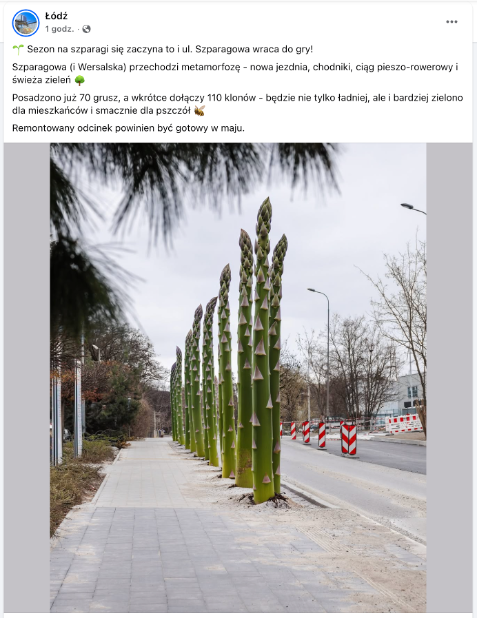
Did Łódź learn its lesson? Not a chance. A moment later, onto the same profile landed a photo of Szparagowa Street — "Asparagus Street" — with, how else, giant asparagus growing along the pavement. AI again. A fake again. This time at least nobody drove over to pick it for soup. Probably.
And now the real problem: the whole administration is already doing it. Quietly.
These three blunders weren't exceptions — three unlucky souls who happened to get caught red-handed. They're the tip of something that already has a name: shadow AI, the grey zone of artificial intelligence in public offices. And I'm not saying this off the top of my head — it comes from research by NASK.
NASK looked into how Poland's public administration really uses AI. The conclusion is that officials reach for publicly available generative tools widely and completely unofficially — often from their private accounts. Not within some secure, official system with rules. Privately. From their home ChatGPT, pasting in whatever happens to be on the desk.
And they don't particularly hide it. In group interviews, officials openly admitted that they already use public tools today to draft letters, documents and content — because it's a huge help, it speeds up the routine, it makes work more comfortable. One of them summed it up with disarming honesty:
"(…) to make work and life easier, everyone uses it, but it isn't formalised with us."
Read that sentence again, slowly. "Everyone uses it" and "it isn't formalised". In other words: we do it on a mass scale and nobody's got a handle on it. And now think about what goes into such letters. Your name. Your address. The case number. Sometimes your PESEL, the data from your application, your entire family situation. And all of it can land in a public AI model, pasted from the private account of an official who simply wanted to finish a letter faster before lunch. Without consent, without control, without any trace.
This is no longer a funny picture off the internet. This is your application in someone else's ChatGPT.
What follows from this — and what I will NOT write here
I could now give you a guide on "how to tell a photo is AI" — garbled lettering, six fingers, gibberish instead of captions. Except that's advice with a shelf life shorter than a yoghurt's. The models are getting better, and in a moment you won't tell an edit from the original by eye — fake photos, voice and video will reach a level where the naked eye stops meaning anything. Teaching you "look at the fingers" today is like teaching you to spot counterfeit banknotes by their smell. Useless within a year.
So we'll go the other way. It's not about being afraid of AI or hunting it down like a detective. It's about learning to use it wisely — because it's here to stay, and these three scandals came not from AI being evil, but from people using it without thinking. Artificial intelligence is like a circular saw: in the right hands it does the job, in random ones it cuts off fingers.
The payload — for you and for every office reading this:
- AI is an assistant, not a source of truth. It's great at suggesting, summarising, drafting. But everything that comes out of it — a photo, a letter, a number — gets checked by a human before it goes out into the world. "Chat rolled in, no vigilance, off it went" is not a procedure. It's a description of a disaster.
- Don't touch generative AI for documentation and evidence. It doesn't "improve" a photo — it creates it anew, guessing how it should look and adding in what isn't there. A photo from a ceremony or an investment is meant to show what was, not a prettier version of what the model made up. You remove a watermark with scissors, not with regeneration.
- Publishing an AI graphic? Label it. One word — "AI graphic" — under the post. That's enough to stop anyone taking a tram to look at non-existent flowers, and to stop you having to explain in the comments afterwards that "it was obvious". If it wasn't, then label it.
- Don't put other people's data into public tools. This is the most important sentence in the whole text. A letter with a citizen's data, an application, anything sensitive — does not land in free ChatGPT from a private account. If an office wants to use AI (and it should!), then on clear rules, on secure tools and after training — not in a grey zone, on the sly.
Because AI in the hands of an office can mean a real speed-up and shorter queues. But without rules and without knowledge it turns into a machine for producing scandals and leaks. And the difference between the two isn't better technology. It's knowing how to use it.
Learn AI consciously — you, me, and that gentleman from the communications department.
View related articles
Lundon! There's Lądek, Lądek Zdrój, yes…
One day, sitting quietly at my computer, I met Kaja. A strange chain of events led me to decide to visit her in Seville, Spain. I planned my trip so as to see London along the way — the city that has become a paradise of riches for Poles.
The Old Market Square in Łódź
As tends to happen at the end of the year, a little grumbling is in order. That Łódź is a different city from all the rest, I probably no longer need to prove to anyone. Sitting in front of my computer, I realised yet another fact that sets this place apart. We have no Old Market Square!
Foggy Wanderings Around Łódź
Some time ago I went on night-time wanderings around Łódź. The city seemed to me empty, sad and gloomy then. On a certain foggy evening I wanted to set out again and capture the beauty that Łódź hides somewhere within itself.