The Eisenhower Matrix, or how to take control of priorities
Go on a break, or maybe reply to that email, or pick up the phone from your boss? In what order should you tackle these tasks so as not to lose control and fall into helplessness? The solution to these problems may be the Eisenhower Matrix (also called the Eisenhower Box or Eisenhower Square).
How do you cope with a large number of tasks that are urgent and have priority? Amid the flood of matters, important things give way to urgent ones, and too much time is devoted to trivial tasks. As a result, taking care of your health, education or contact with loved ones recedes into the background. How do you deal with this?
Table of Contents
There's only one priority
Shock and disbelief, but that's how it is. A priority means the privilege of precedence, and only one thing can be first. The word, borrowed from the Latin prior, is today used more in the plural and denotes the order or importance of a given task. Terms appear such as first priority, most important, greater, higher and the like. This only causes chaos. That's why some tool to put it in order would come in handy.
Important versus urgent tasks
The matters to be done can be divided into two groups: urgent and important.
I have two kinds of problems: the urgent and the important. The urgent are not important, and the important are never urgent.
Dwight Eisenhower
Eisenhower believed that what's important is rarely urgent, and what's urgent is rarely important. So how do you tell urgent matters from important ones?
Urgent tasks
When we talk about urgent matters, we mean all those that have a set deadline - and it's very near. This time can vary depending on the type of task and last from a few hours to even days.
Urgent tasks require practically immediate action; they're very often a reaction to signals from the environment. A sudden phone call from the boss, illness, an approaching project deadline, etc. These tasks cause frustration, stress and disrupt a previously arranged plan of action.
If tasks of this kind dominate your list, then you probably aren't coping with time management and assertiveness. Clients or your superior can very easily throw in tasks that are urgent, but don't necessarily have to be important.
Important tasks
With important tasks it's completely different. They don't require immediate action, which is why they get set aside and neglected. Over time they become urgent tasks and the firefighting begins.
Important tasks are those that are a certain goal, a mission, and are guided by values. Carrying out important tasks comes with major consequences - positive ones, or negative ones if neglected.
Matters of this kind have the greatest significance; they affect the quality of work or life from a longer-term perspective. An example of such tasks is, e.g., self-education, taking care of your health.
Focus on what's important, or what's urgent?
Urgent and important matters are constantly fighting for our attention. Unfortunately, we give in to the former too often, and those that, over time, will give us more, are ignored. Eisenhower created a method that served to increase personal productivity and today it's called the Eisenhower Matrix.
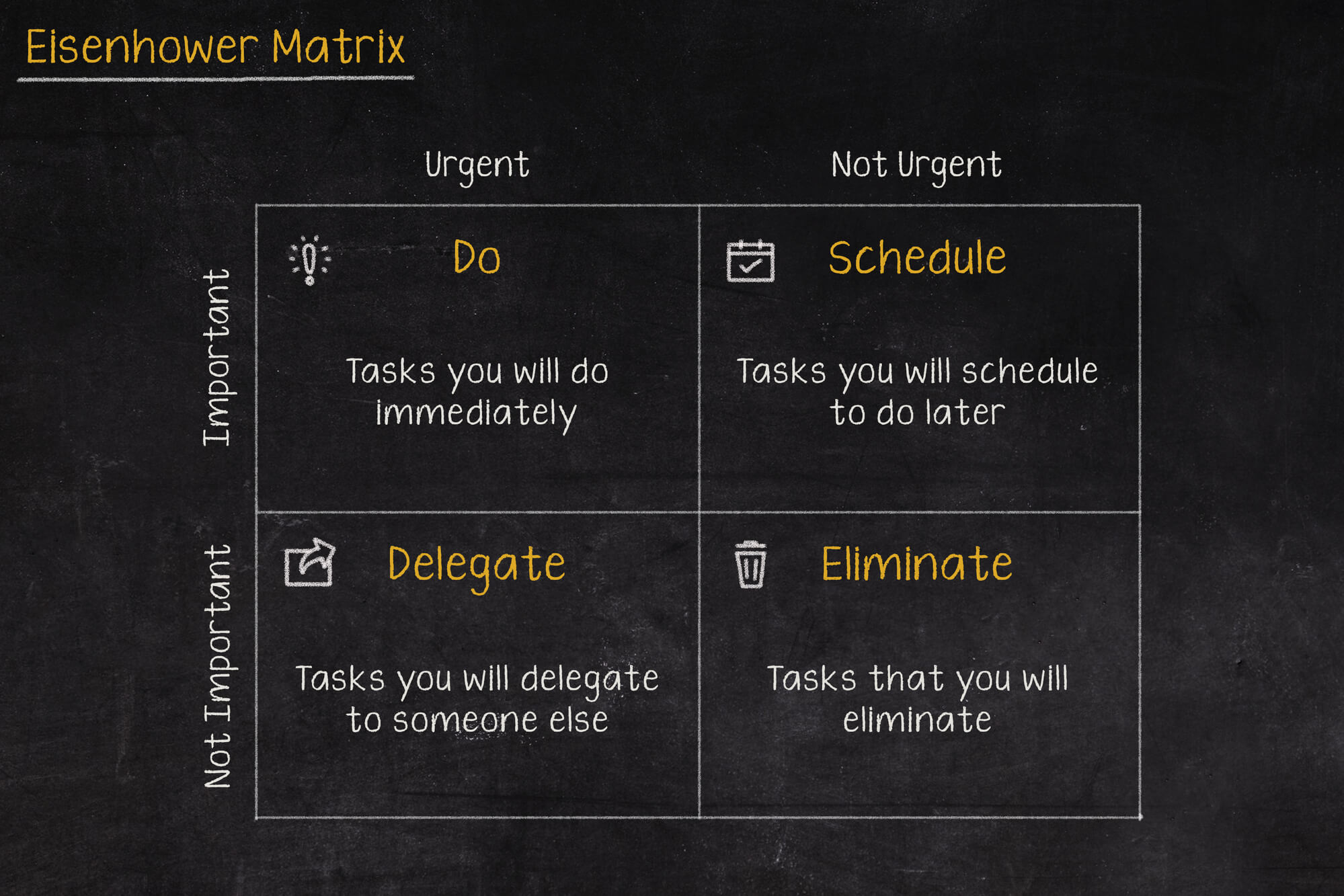
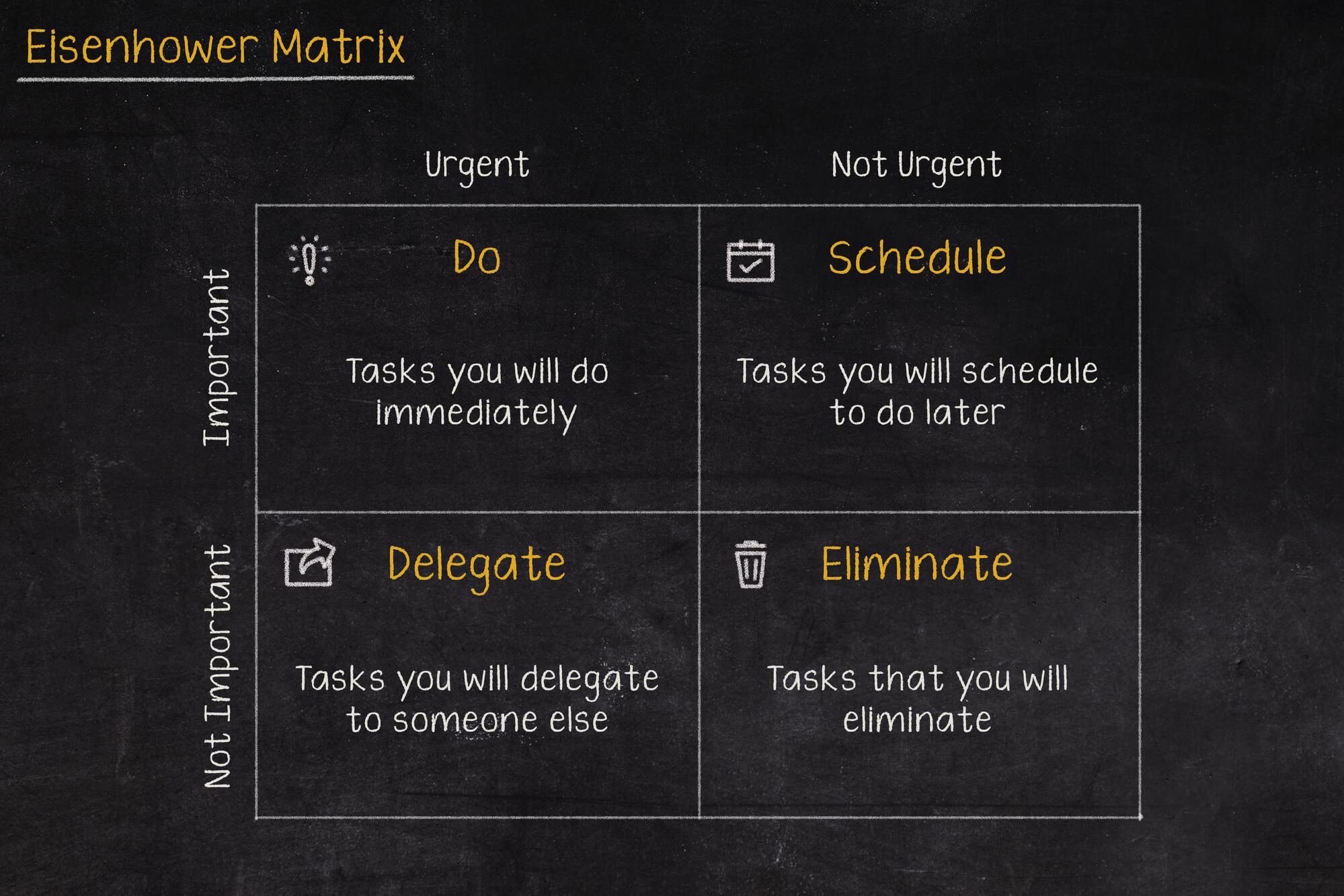
This tool lets you organise tasks into four quadrants and assign them importance and priority.
Why do we "like" urgent tasks?
Which tasks would you describe as the priority ones? Probably those that need to be done in the near future. Acting on reflex, our brain will choose the tasks that need to be done here and now. All the matters, emails titled ASAP, generate enormous emotions in us and that's why we reach for them. Tasks with a near deadline are sexy to our brain! Their effects are more and faster visible, the tasks themselves demand to be dealt with and prompt us to immediate action.
If we don't learn to correctly classify the importance of tasks, and only ASAPs are important to us, our life will look like eternal firefighting. Urgent and important matters will constantly compete for our attention.
The Eisenhower Matrix
The matrix divides tasks into four groups, arranging them by urgency and importance:
- Quadrant I – urgent and important,
- Quadrant II – important, but not urgent,
- Quadrant III – urgent, but not important,
- Quadrant IV – neither urgent nor important.
Quadrant I - urgent and important
The most thrilling and hottest quadrant in the Eisenhower Matrix! It's here that we put out fires, struggle with the short time to complete important tasks. The more of them we have in this area, the more problems we generate. Working on tasks from this quadrant causes a feeling of tension, stress and fatigue or professional burnout.
The tasks from the first quadrant are all those that you have to deal with now or as soon as possible. Their deadline is very near and the consequences of not completing them are major. Here you classify all the matters that brook no delay, which may have suddenly arisen:
- failures, crises, emergencies,
- illness situations,
- approaching deadlines for submitting documents,
- studying for tomorrow's exam,
- the sudden recruitment of a new employee after the previous one left,
- preparing a presentation for tomorrow's conference.
The tasks from this quadrant are also the result of neglect and putting off important matters, and unfortunately that's the majority. Putting off important tasks for later most often ends in firefighting, e.g. you can plan changing your tyres from summer to winter at a time convenient for you, rather than waiting until the last moment and standing in long queues at the garage. The same goes for taking care of your health, paying bills. Leaving important tasks and not keeping an eye on them will take revenge in the form of sudden ASAPs.
Quadrant II - important, but not urgent
Here are all the important matters that have no deadline. It's the ideal place for long-term strategy, achieving goals and dreams. Carrying out tasks from this quadrant prevents fires.
By focusing on the tasks from this quadrant, we're proactive and plan our time. We deal only with important tasks, deadlines aren't chasing us and completing them gives a lot of satisfaction. It's in this quadrant that we enter tasks such as:
- creating procedures in the company,
- developing a customer service standard,
- the company's marketing strategy,
- content marketing,
- planning the company budget,
- training.
Carrying out these tasks gives long-term results and prevents failures. A well-trained employee makes fewer mistakes, a developed marketing strategy attracts new customers, etc. Your well-being, the quality of your work and the size of your income depend on carrying out these tasks.
Quadrant III - urgent, but not important
The illusion of important tasks, other people's priorities - that's how you can describe this quadrant. Here are tasks that aren't important to us but are urgent for someone else. These are all sorts of things thrown in by other people. Wanting to avoid the feeling of guilt that we're not helping a work colleague, we focus on these tasks. Long work in such a state causes frustration, a failure to complete important tasks and a feeling of wasted time.
Taking on the role of rescuer, we take onto our shoulders more topics that are unimportant to us, e.g.:
- something thrown in by a superior, which we're not held accountable for,
- a request from a work colleague to explain a topic again, just because they didn't write it down,
- preparing reports that no one reads,
- another pointless teleconference, or "let's hop on a call".
Quadrant IV - neither urgent nor important
Tired of working in the other quadrants, we escape to Quadrant IV. It's here that all sorts of time-wasters are found, which pull us away from completing specific tasks. Many of these tasks can create the illusion of productivity. Spending a long time in this quadrant causes a lowering of your self-worth, wasted time and various kinds of addictions.
Example tasks are:
- work meetings you're not a stakeholder in,
- scrolling through social media,
- long office chats, waffling,
- colouring in last year's reports in Excel,
- ideas of the "it would be nice to do..." type.
Quadrant IV is the ideal place for killing time, a way of pushing important matters aside and an excuse that we're not wasting time - because, after all, we're doing something.
Drawbacks of the Eisenhower Matrix
Paper will take anything, just as we can enter any tasks into the matrix. In life it's no longer so rosy and this tool may not be enough. It works perfectly for ordering matters at a high level of generality, or quickly classifying tasks to be done. In everyday life, I wouldn't use it.
Another problem is assigning a task to a category. What's category I for me may be in III for someone else.
The next problem is delegating tasks from quadrant III. If we work alone or are a rank-and-file employee, then who are we supposed to delegate tasks to? The matrix works on the highest positions, where at a general level we can plan things out and it's we who decide their priority.
The matrix works poorly when we have someone above us (a manager, a boss) and they can change the importance of tasks or their priority.
Summary
Despite many drawbacks, the Eisenhower Matrix is a simple tool that works at a very general level. It shows the direction we're heading in and helps, to a certain extent, to focus on the most important tasks.
We can use the matrix to generally plan a day, a week or a month, focusing on the most important tasks and eliminating time-wasters. And that's the greatest advantage of the Eisenhower Matrix - putting the emphasis on focus and elimination.
View related articles

How do procedures and checklists make work easier?
Procedures, checklists and writing down tasks accompany me at every step: from work and hobbies to various duties. These three amazing tools make the day have more hours, mean that boring, repetitive things started being done by automated processes, and made delegating tasks simpler.

IT outages happen to everyone
For the past few hours the internet messenger Slack has been down. A few weeks ago you couldn't use Google's services, and even earlier a large part of the Internet wasn't working because of an outage of Cloudflare's services. Is it possible that cloud services are unavailable?

Should the RCB Alert inform about the presidential elections?
Communication in an emergency is one of the more important topics covered during sailing, flying or diving. Warnings can save lives, which is why they shouldn't be treated lightly, and even more so shouldn't, by their wording, lead to their being ignored.